

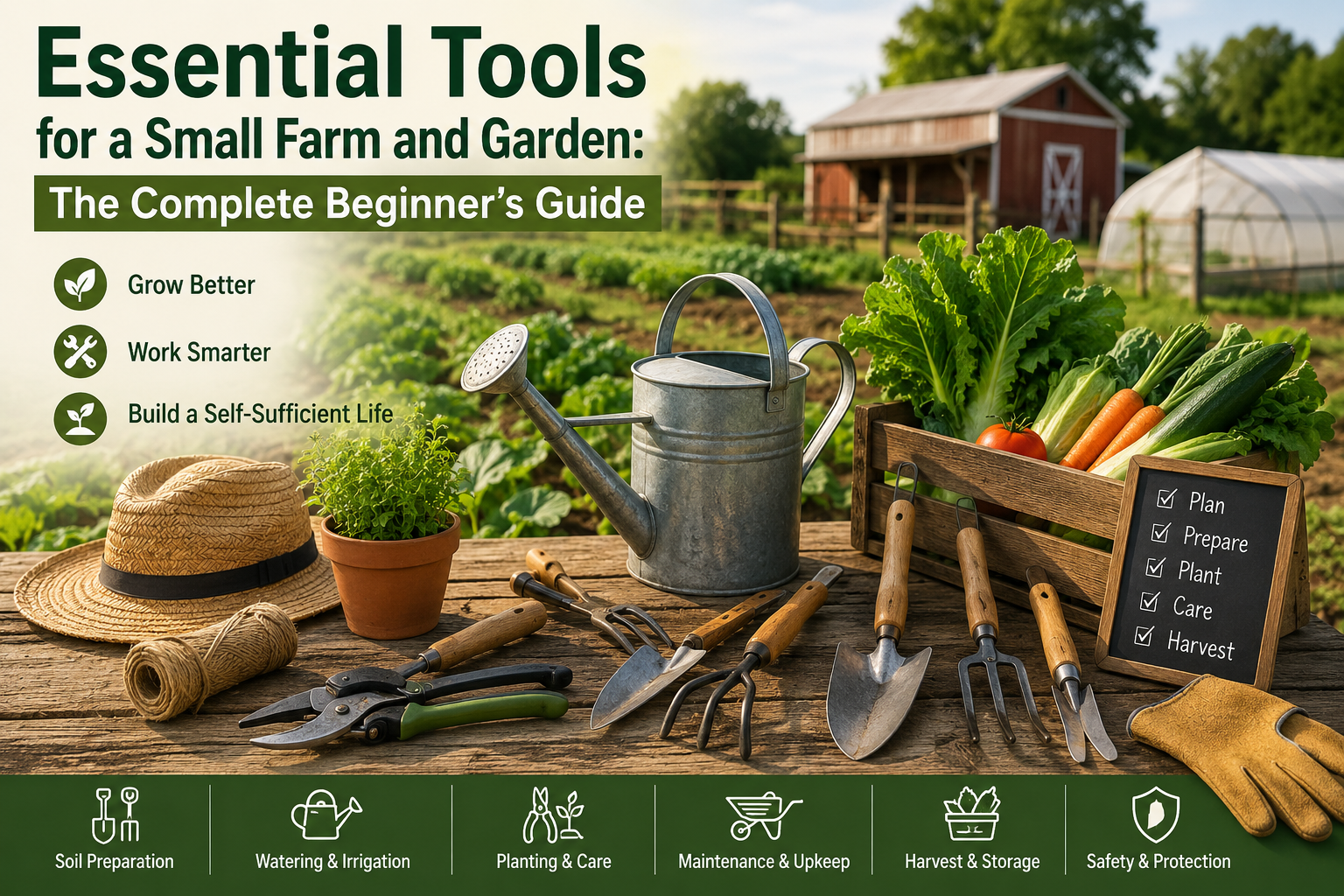
If you are thinking about starting your own farm or homestead, you have probably already considered animals, crops, seeds, fencing, and finding the right piece of land.
However, there is one important part of farm life that is often overlooked until something breaks: tools.
Even a small farm requires constant maintenance. You may need to repair fences, prepare soil, prune trees, cut branches, clean animal areas, build structures, maintain crops, or fix small problems around the property.
That is why having the essential tools for a small farm and garden is not simply a matter of convenience. The right tools can save you time, physical effort, and money, especially when many maintenance projects can be handled through DIY work.
The good news is that you don’t need to buy an enormous collection of tools on day one.
In fact, one of the most common mistakes beginners make is buying too many tools before they actually know what they will use them for. A much smarter approach is to start with a small collection of durable, versatile tools and expand it as your farm and projects grow.
In this guide, we’ll look at the tools you should consider for a small farm and garden, what each one is useful for, which ones should come first, and how they can help with different DIY projects around your homestead.
Why Does a Small Farm Need So Many Tools?
A small farm can look simple from the outside: a few plants, perhaps some animals, a vegetable garden, and an area for storing supplies.
But once you start working on it, you quickly discover that almost everything requires maintenance.
- A fence can break.
- A gate can come loose.
- A branch can fall after a storm.
- The soil may need to be prepared.
- A pipe may start leaking.
- A chicken coop may need repairs.
- A ree may need pruning.
And then comes the famous sentence:
” Ineed a tool for this“.”The problem is that buying a different tool for every single task can quickly become expensive. That is why it makes sense to focus on versatile tools.
For example, a good shovel can be used to prepare soil, plant trees, dig small holes and trenches, move compost, and perform many other jobs.A well-organized toolbox can become one of the most valuable assets on a small farm.
1. Shovel: One of the Most Basic Farm Tools
If you could choose only a handful of tools to start with, a shovel should be near the top of the list.
Shovels can be used for digging, moving soil, handling compost, preparing planting holes, working around crops, and performing general maintenance. There are several different shovel designs, but for a small farm, it is useful to have at least one digging shovel and, eventually, a larger square-point shovel.
A pointed digging shovel is particularly useful for breaking into soil and digging holes. A square-point shovel works better when you need to move materials such as soil, compost, sand, or plant debris.
What Should You Look For?
You don’t necessarily need the most expensive shovel available. Instead, look for:
- A strong handle.
- A durable steel blade.
- A solid connection between the blade and handle.
- A comfortable grip.
- A length that fits your height.
A cheap tool that constantly breaks can end up costing more than a reasonably priced quality tool.
2. Garden Hoe for Preparing Soil
A garden hoe is another one of the essential tools for a small farm and garden. Its primary purpose is to work the soil, remove weeds, and prepare areas for planting. It can also be used to create shallow planting furrows, loosen surface soil, and work around certain plants.
If you grow vegetables, herbs, or ornamental plants, you will probably use a hoe frequently. One important recommendation is not to use it as a replacement for every other tool. Each tool is designed for a particular job. Using a hoe for extremely heavy work can bend the blade or damage the handle.
3. Garden Rake
After digging, pruning, mowing, or working the soil, you eventually have to clean everything up. That’s where a garden rake comes in.
A rake can be used to:
- Gather leaves.
- Spread soil.
- Level surfaces.
- Collect plant debris.
- Prepare certain areas of the garden.
- Clean pathways.
- Distribute lightweight materials.
For a small farm, it can be useful to have a leaf rake as well as a heavier garden or landscape rake. They are not exactly the same tool, and forcing a leaf rake to work on hard soil is a surprisingly effective way to break it.
4. Garden or Compost Fork
A garden fork becomes particularly useful when you start working with compost, hay, leaves, plant debris, or organic materials. It can also be used to turn and aerate certain materials and move them from one location to another.
If your small farm produces compost, a sturdy garden fork can save a significant amount of physical effort. If you keep livestock, it can also be useful for handling bedding materials. The amount of work you can save simply by using the right tool can be substantial.
5. Pruning Shears
If you have trees, shrubs, fruit trees, or ornamental plants, pruning shears are practically essential. Pruning shears allow you to cut smaller branches and keep plants under control. A good pair should have durable blades and a mechanism that allows clean cuts.
This matters because low-quality tools may crush branches instead of making clean cuts. You should also keep the blades clean and sharp. A properly maintained pruning tool doesn’t just work better; it also makes the job easier.
6. Pruning Saw
When branches become too thick for pruning shears, you’ll need a pruning saw. A pruning saw is especially useful for fruit trees and for maintaining areas with larger trees or dense vegetation. You don’t need an entire collection of saws when you’re starting out.
A good hand pruning saw can handle many jobs. It also doesn’t require fuel, electricity, or batteries, which means it is always ready when you need it. That is exactly what you want from an emergency tool.
7. Hammer: Essential for Farm DIY
This is where DIY work really begins. If you own a farm or homestead, sooner or later you will build or repair something. A hammer can be used to:
- Repair fences.
- Build wooden structures.
- Drive nails.
- Repair gates.
- Build storage boxes.
- Perform general repairs.
A medium-sized hammer of good quality is enough to get started. You don’t need five different hammer designs. As you take on more specialized projects, you can expand your collection.
8. Screwdriver Set
Screwdrivers seem like extremely basic tools until you need one and don’t have one. On a farm, screws can be found almost everywhere: gates, hinges, tools, pumps, irrigation systems, storage structures, furniture, and electrical equipment.
Ideally, you should have several sizes and different tip types. A basic set should include Phillips and flat-head screwdrivers in different sizes. As you take on more DIY projects, you can add interchangeable bits and other specialized drivers.
9. Wrench Set and Adjustable Wrench
Mechanical and maintenance work requires a different set of tools. A wrench set can be useful for repairing small machinery, tightening hardware, assembling structures, and handling certain plumbing jobs.
An adjustable wrench is also extremely versatile. It won’t replace every wrench you could possibly need, but it can solve many problems when you’re just getting started. If you have farm machinery, trailers, or small engines, you’ll probably eventually need additional mechanical tools.
10. Pliers
Pliers take up very little space and can be used for a surprising number of jobs.
They are useful for:
- Holding parts.
- Cutting wire.
- Bending materials.
- Removing nails.
- Working with fencing.
- Performing general repairs.
For a farm, a pair of standard combination pliers is an excellent starting point. Later, you can add wire cutters, needle-nose pliers, locking pliers, and other designs as needed.
11. Wire Cutters
If you have fencing, chances are you’ll have wire. And if you have wire, eventually you’ll need to cut it. A sturdy pair of wire cutters can make fence repairs significantly easier. This is one of those small tools that seems unimportant until an emergency happens.
A broken fence usually doesn’t wait until you have time to drive to the hardware store.
12. Tape Measure
Building without measuring properly is a very efficient way to end up building something twice. A tape measure is essential for almost every DIY project.
You’ll use it to measure:
- Fences.
- Gates.
- Shelving.
- Chicken coops.
- Sheds.
- Workbenches.
- Garden beds.
- Wooden structures.
A durable tape measure with a reach of several feet is more than enough to get started.
Would you like to be part of our weekly newsletter? At HomeToolsStavk, we analyze businesses built from scratch, starting with simple tools and equipment and growing into profitable ventures. Discover what you need to get started, how to scale, and whether the idea is really worth pursuing.

13. Level
If you’re building a structure, you need to know whether it is level. A spirit level may seem unimportant if you’ve never done DIY projects before, but it can make a huge difference in the final result.
Use it when installing gates, building shelves, assembling structures, and checking surfaces. A project might still work if it is slightly crooked, but that doesn’t mean it should be.
14. Wheelbarrow
This is one tool that can save a considerable amount of physical effort.
A wheelbarrow allows you to move:
- Soil.
- Compost.
- Rocks.
- Leaves.
- Lumber.
- Tools.
- Plant debris.
- Building materials.
On a small farm, you’ll probably be moving materials constantly. A sturdy wheelbarrow can last for many years when properly maintained. Pay particular attention to the wheel because it is one of the components that handles the most stress.
15. Cordless Drill
If you want to take farm DIY seriously, sooner or later you’ll need a drill.A modern cordless drill is especially useful because you can use it away from electrical outlets.It can be used for:
- Drilling into wood.
- Driving screws.
- Building structures.
- Repairing gates.
- Installing shelving.
- Building boxes.
- Repairing equipment.
If you could only buy one power tool at the beginning, a cordless drill/driver could be one of the best investments.Look for a battery platform that offers several compatible tools.This allows you to expand your collection later without buying completely different batteries and chargers for every tool.
16. Circular Saw
A circular saw can dramatically expand your DIY capabilities. You can use it to cut lumber for structures, shelves, storage boxes, workbenches, and various farm projects.However, there is an important difference between this and manual tools: power tools require greater attention to safety.
Never use a power saw without first understanding how it works and the risks involved.Wear appropriate eye and hearing protection and follow the manufacturer’s instructions. The speed of a power tool can turn a small mistake into a serious accident.
17. Chisel and Pry Bar
These tools may not be used every day, but they can be extremely useful during repairs and construction projects. A pry bar can help you dismantle structures, remove lumber, or separate certain materials.
Chisels can be used for woodworking and making adjustments during carpentry projects.They aren’t the first tools I would buy for a new farm, but they can become useful additions as your workshop grows.
18. Garden Hose and Basic Irrigation Equipment
Not every useful tool has to be designed for construction.Water is one of the most important resources on any farm or garden.A durable garden hose can be used to water crops, clean work areas, and deliver water where it is needed.
If you have a vegetable garden, you can also explore more efficient irrigation systems, such as drip irrigation.The goal should be to use water intelligently.On a farm, wasting water doesn’t just increase your workload; it can also increase your operating costs.
19. Durable Buckets and Containers
These aren’t sophisticated tools, but you’ll probably use them constantly.
A bucket can be used to transport:
- Water.
- Compost.
- Soil.
- Feed.
- Tools.
- Materials.
- Plant debris.
A good strategy is to buy durable containers and dedicate some of them to specific tasks.For example, you shouldn’t use the same container for animal feed and chemical cleaning products.Organization is also part of farm safety.
20. Personal Protective Equipment
This isn’t technically a tool, but it belongs on your essential farm equipment list.
At a minimum, consider:
- Work gloves.
- Safety glasses.
- Hearing protection.
- Appropriate work boots.
- Durable work clothing.
- Respiratory protection when required.
Tools aren’t necessarily dangerous by themselves. The problem occurs when they are used incorrectly or without appropriate protection.A saw, chainsaw, grinder, or even a basic hand tool can cause injuries.Saving money by skipping safety equipment is a terrible strategy.
Which Tools Should You Buy First?
If you’re starting a farm from scratch, you don’t need to purchase every tool on this list immediately.A much smarter strategy is to divide your purchases by priority.
Basic Starter Kit
These would be my first purchases:
- Shovel.
- Rake.
- Hoe.
- Pruning shears.
- Hammer.
- Screwdriver set.
- Pliers.
- Wrench set.
- Tape measure.
- Wheelbarrow.
- Work gloves.
- Safety glasses.
With this collection, you can handle a surprisingly large number of jobs.
Second Level
Next, I would add:
- Cordless drill.
- Hand saw.
- Garden fork.
- Wire cutters.
- Level.
- Adjustable wrench.
- Pry bar.
- Additional pruning tools.
Third Level
As the farm grows:
- Circular saw.
- Angle grinder.
- Air compressor.
- Pneumatic tools.
- Specialized cutting tools.
- Additional power tools compatible with your battery platform.
The principle is simple:
Buy tools to solve real problems, not tools to fill a workshop.
How to Organize Tools on a Small Farm
Having good tools isn’t very useful if you can never find the one you need.One of the first DIY improvements you can make on your farm is to create a dedicated tool storage area. It doesn’t need to be complicated. You could use a wall-mounted tool rack, pegboard, wooden shelving, or a small storage shed.
The most important rule is that every tool should have a designated place.After using it, put it back.It sounds boring, but it saves a surprising amount of time.It’s also a good idea to keep gardening tools, mechanical tools, and tools used around livestock separated whenever practical.How to Keep Your Farm
How to Keep Your Farm Tools in Good Condition
Buying a quality tool is only half the job.The other half is maintaining it.After using garden tools, remove dirt and moisture. Metal tools can rust if they remain wet for extended periods.Cutting tools should be kept sharp.Wooden handles should be inspected regularly for cracks or damage.
Power tools should be stored properly, and batteries should be maintained according to the manufacturer’s instructions.Also, never ignore damaged tools.A shovel with a broken handle or pruning shears with a defective mechanism can cause accidents.
DIY Projects You Can Build With Your Farm Tools
One of the biggest advantages of owning tools is that you can use them to build more things.For example, with lumber, screws, a drill, a saw, and some basic hand tools, you can build:
- Workbenches.
- Storage shelves.
- Storage boxes.
- Planter boxes.
- Compost bins.
- Feeders.
- Small structures.
- Tool racks.
- Work tables.
- Organizers.
This can significantly reduce the cost of equipping a small farm.And this is one of the best reasons to learn DIY skills: you don’t just learn how to repair things; you learn how to build solutions.
Should You Buy Cheap Tools or Invest in Quality?
The answer isn’t as simple as “always buy the most expensive tool.”An extremely cheap tool can be a poor investment if it breaks quickly.But it also doesn’t make sense to spend a fortune on a tool you’ll use twice a year.A smarter strategy is to identify the tools you’ll use frequently and invest more in those. For example:
- Shovel: medium to high quality.
- Wheelbarrow: medium to high quality.
- Pruning shears: good quality.
- Cordless drill: good quality.
- Specialized tools: buy them when you actually need them.
Think of your tools as farm assets.A tool you use hundreds of times can easily justify a higher upfront investment.
How to Build a Basic Farm Workshop
If you have enough space, even a small workshop can completely change the way you work.You don’t need to start with a huge building.You can begin with: A workbench + storage + good lighting + basic tools.
The workbench should be sturdy enough for repairs and DIY projects.You can install storage systems above or around it to keep tools organized.Good lighting is also important.A dark workshop is an unnecessary invitation to make mistakes.Over time, you can add tools according to the projects you actually take on.A good philosophy is to let your work determine what you buy next.
The Most Important Tools Aren’t Always the Most Sophisticated
There is a tendency to become obsessed with buying power tools and professional equipment.But a small farm doesn’t need to become an industrial workshop overnight.
- A shovel can solve a problem that no drill can.
- A good pair of pliers can repair a fence.
- A hammer can build a structure.
- A wheelbarrow can save hundreds of trips carrying materials by hand.
- And a good pair of pruning shears can help maintain a garden for years.
Technology has its place, but hand tools remain fundamental.In fact, on a small farm, you will probably use some hand tools much more often than your power tools.
Essential Tools for a Small Farm and Garden: Final List
If you want to start with a practical collection, here’s a useful reference list.
Garden Tools
- Shovel.
- Hoe.
- Rake.
- Garden fork.
- Pruning shears.
- Pruning saw.
- Wheelbarrow.
- Garden hose.
- Buckets.
DIY Tools
- Hammer.
- Screwdriver set.
- Pliers.
- Wrench set.
- Tape measure.
- Level.
- Wire cutters.
- Pry bar.
- Cordless drill.
- Hand saw.
Power Tools to Add Later
- Circular saw.
- Angle grinder.
- Sander.
- Air compressor.
- Other tools compatible with your battery platform.
Safety Equipment
- Work gloves.
- Safety glasses.
- Hearing protection.
- Work boots.
- Appropriate work clothing.
- Respiratory protection when necessary.
Conclusion: Start Small and Build Your Tool Collection Over Time
Starting a farm doesn’t mean buying every tool available at the hardware store.It means having the right tools for the problems that actually occur on your property.If you’re just getting started, focus your budget on basic, durable, versatile tools.
A shovel, hoe, rake, wheelbarrow, pruning shears, and a basic DIY tool set can allow you to handle a huge number of tasks.Then, as your crops, livestock, structures, and projects grow, you can expand your workshop.The real advantage of learning farm DIY isn’t simply spending less money on repairs.It’s developing the ability to look at a problem and think:”Can I build or repair this myself?”
That mindset can ultimately be much more valuable than any individual tool.A small farm will always have something to repair, build, modify, or improve. The better equipped you are, the more problems you can solve yourself.
So before spending hundreds or thousands of dollars on equipment, start with the essentials.Buy a tool because you have a job to do, learn how to use it properly, and let your farm show you what your next purchase should be.That’s probably the smartest way to gradually build a workshop that is genuinely useful for your farm and garden.




Leave a Reply