

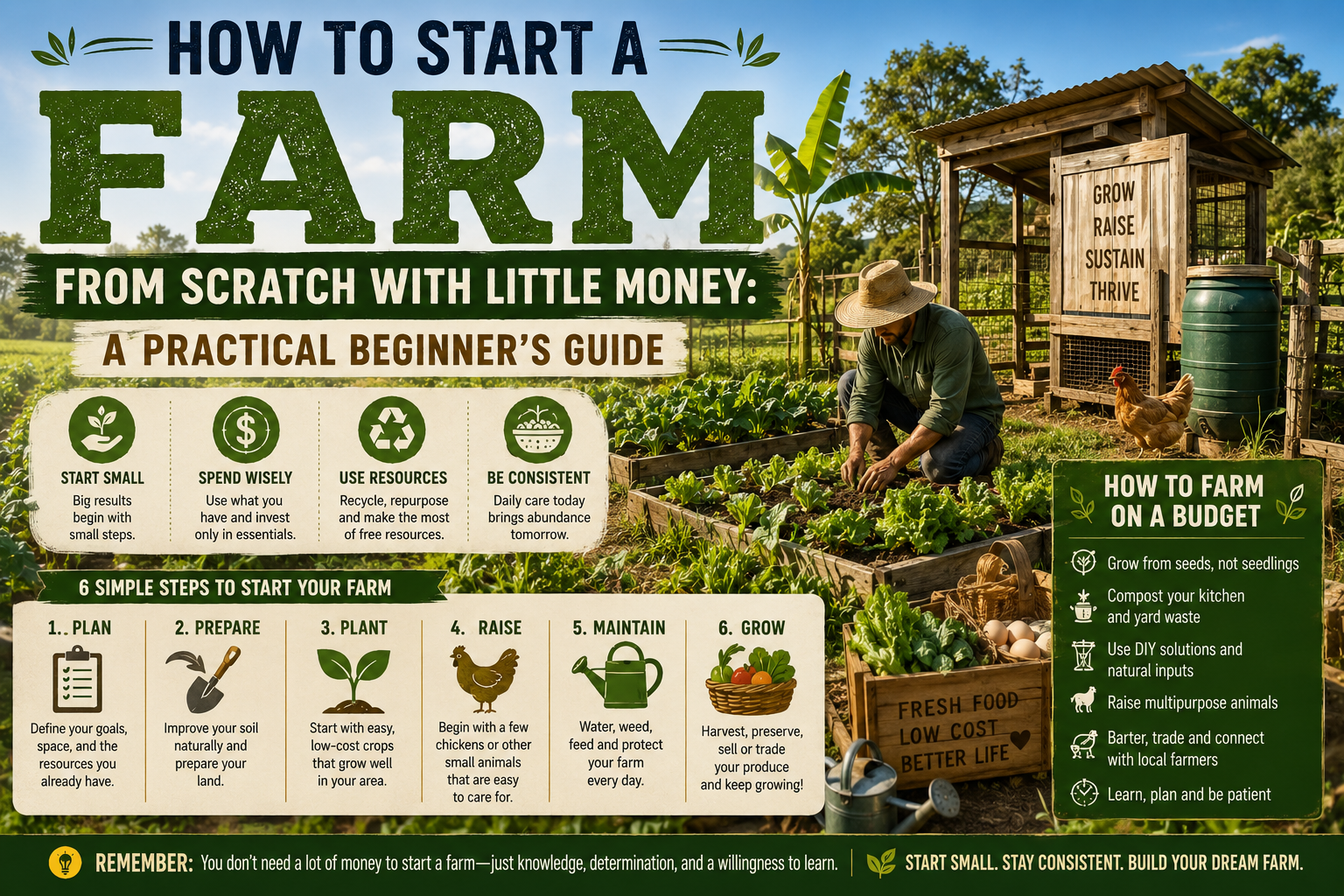
Starting a farm can seem like a project reserved for people with large amounts of land, agricultural machinery, and thousands of dollars available to invest. However, that image doesn’t necessarily reflect reality. It is possible to start with a relatively small piece of land, a few tools, and a limited budget if you develop a realistic plan and avoid trying to build everything at once.
The key is understanding that a farm doesn’t have to be finished before it starts working. You can begin with a small vegetable garden, a few productive plants, a composting area, or a handful of animals, and gradually expand the project as you gain more experience and resources. Your initial goal shouldn’t be to build the farm of your dreams, but to establish a foundation that you can afford to maintain.
In this guide, you’ll learn how to start a farm from scratch with little money, how to decide what to produce, which expenses to avoid, what tools to buy first, and how to use DIY strategies to reduce costs. We’ll also look at common mistakes that can quickly consume the budget of someone just getting started.
Is It Really Possible to Start a Farm with Little Money?
Yes, but we need to define what “little money” actually means. A large-scale commercial farm requires significant investments in land, machinery, infrastructure, irrigation systems, storage, permits, and other resources. Trying to build that kind of operation with a few hundred dollars isn’t realistic. A small family farm or small-scale agricultural operation, however, can start on a much more modest scale.
The main difference is size and growth speed. Instead of buying everything you need on day one, you can develop the property in stages. One season you might focus on a vegetable garden; later you could add a chicken coop, then fruit trees, and eventually develop other production areas. This strategy reduces your initial investment and allows you to learn before committing large amounts of money.
It’s also important to distinguish between a farm designed for self-sufficiency and one designed to generate income. If your goal is to feed your family, your priorities will be different from those of someone who wants to sell eggs, vegetables, plants, or processed products. Before spending money, decide which of these goals is your priority.
1. Decide What Kind of Farm You Want to Create
The first step isn’t buying animals, seeds, or tools. It’s deciding what you want your farm to produce. A property can be used to grow vegetables, raise poultry, produce eggs, keep small livestock, grow fruit trees, produce honey, grow herbs, or combine several activities.
The problem with trying to do everything from the beginning is that every activity requires infrastructure, knowledge, tools, feed, and time. Someone who tries to raise chickens, goats, and pigs while growing twenty varieties of vegetables and establishing a complete orchard during their first year can quickly spend a lot of money without mastering any of these activities properly.
A much better strategy is to start with one or two production areas. For example, you could begin with a small vegetable garden and laying hens. Once both activities are operating successfully, you can decide whether adding another activity makes sense. Starting simply may seem boring, but it is one of the best ways to control expenses.
2. Start with What You Already Have
Before buying anything, make an inventory of the resources you already have available. This includes land, tools, containers, construction materials, water sources, wood, knowledge, time, and contacts who may be able to help you.
Many people start looking for products in stores before analyzing their own resources. This can lead to unnecessary purchases. An old container might become a planter, reclaimed boards could be used to build a compost bin, and certain materials could be repurposed to create simple structures.
The principle is simple: use available resources first and buy only what you actually need. This doesn’t mean using dangerous materials or building unsafe structures. It means thinking like someone managing a limited budget and trying to maximize every dollar invested.
3. Land Is More Important Than the Amount of Money
If you don’t already own land and are thinking about buying some, don’t focus solely on the purchase price. Cheap land can become extremely expensive if it doesn’t have adequate water, requires extensive preparation, has difficult access, or comes with restrictions that make agricultural use difficult.
Before buying, examine factors such as water availability, drainage, soil quality, sunlight exposure, accessibility, terrain, and the possibility of building the structures you’ll need. You should also research local regulations regarding livestock, construction, wells, septic systems, and agricultural activities.
A slightly more expensive property that is suitable for your project can be much cheaper in the long run than a cheap property requiring thousands of dollars in improvements. The purchase price is not the total cost of a farm.
4. You Don’t Need to Start with a Large Amount of Land
One of the biggest myths about starting a farm is that you need hundreds of acres. For a small operation, this isn’t necessarily true.
A relatively small piece of land can produce a significant amount of food if it is used efficiently. A well-planned vegetable garden can produce different crops throughout the year, while fruit trees and perennial plants can make use of spaces that might otherwise remain unused.
Starting with less land can actually be an advantage. You’ll have less area to maintain, less infrastructure to build, and fewer resources to purchase. If you later discover that you genuinely need more space, you can expand the project once you have more experience and a more stable source of income.
5. Create a Budget Before Buying Anything
One of the fastest ways to run out of money on a farm is to start buying things without a budget.
Before spending, divide potential investments into categories. You might consider land, water, fencing, tools, seeds, animals, feed, structures, storage, and maintenance.
Then classify every expense as essential, useful, or optional. Essential items are those without which the project cannot operate safely. Useful items improve the operation but can wait. Optional items are things you’d simply like to have.
This classification prevents you from spending your initial budget on secondary items while basic problems remain unresolved.
6. Start with Water
If there’s one resource that can determine whether a small farm succeeds or fails, it’s water.
Plants need water. Animals need water. Young crops may require frequent irrigation. Even some cleaning and maintenance activities depend on a reliable water source.
Before planting large quantities or buying livestock, determine where your water will come from and how much it will cost to obtain it. Depending on your location, you might use an existing water supply, rainwater storage, or other systems permitted by local regulations.
Don’t assume that owning land automatically means you have adequate water available. A farm without a reliable water supply can quickly become a much more expensive project than expected.
7. Start a Small Vegetable Garden
A vegetable garden can be one of the most accessible ways to begin a small farm.
You don’t need to cultivate an entire acre during your first season. In fact, starting with a small area can be much smarter. It allows you to learn about soil, irrigation, pests, fertilization, seeds, and growing cycles without taking on excessive expenses.
Choose crops that are suitable for your climate and that have a real use for you or a potential market. Growing something simply because it looks interesting can end up wasting time and resources.
Once you understand how your first garden performs, you can gradually expand the growing area.
8. Learn to Improve Your Soil Before Spending Money on Fertilizers
Soil is one of the most important assets on a farm. Constantly buying fertilizer can become a significant expense, especially as the cultivated area increases.
An economical strategy is to learn how to improve organic matter in the soil through compost, plant residues, and other practices appropriate for your growing system. Composting can transform organic waste into a useful resource for the garden.
However, this doesn’t mean every soil problem can simply be solved by adding compost. It’s worth understanding the characteristics of your soil and, when necessary, conducting soil tests so you can make decisions based on actual data.
9. Compost Instead of Wasting Resources
A simple compost bin can become one of the first structures on a small farm.
Plant scraps, leaves, certain organic materials, and other suitable inputs can be transformed into compost under the right conditions. This allows you to make use of resources that would otherwise end up in the trash.
You can build a simple compost bin using reclaimed wood or other appropriate materials. You don’t need to start with a sophisticated system.
Besides reducing waste, composting can become an important part of your soil fertility system. The idea is to create a small cycle where certain farm resources return to the soil rather than leaving the property.
10. Buy Tools Strategically
You don’t need to buy every agricultural tool available.
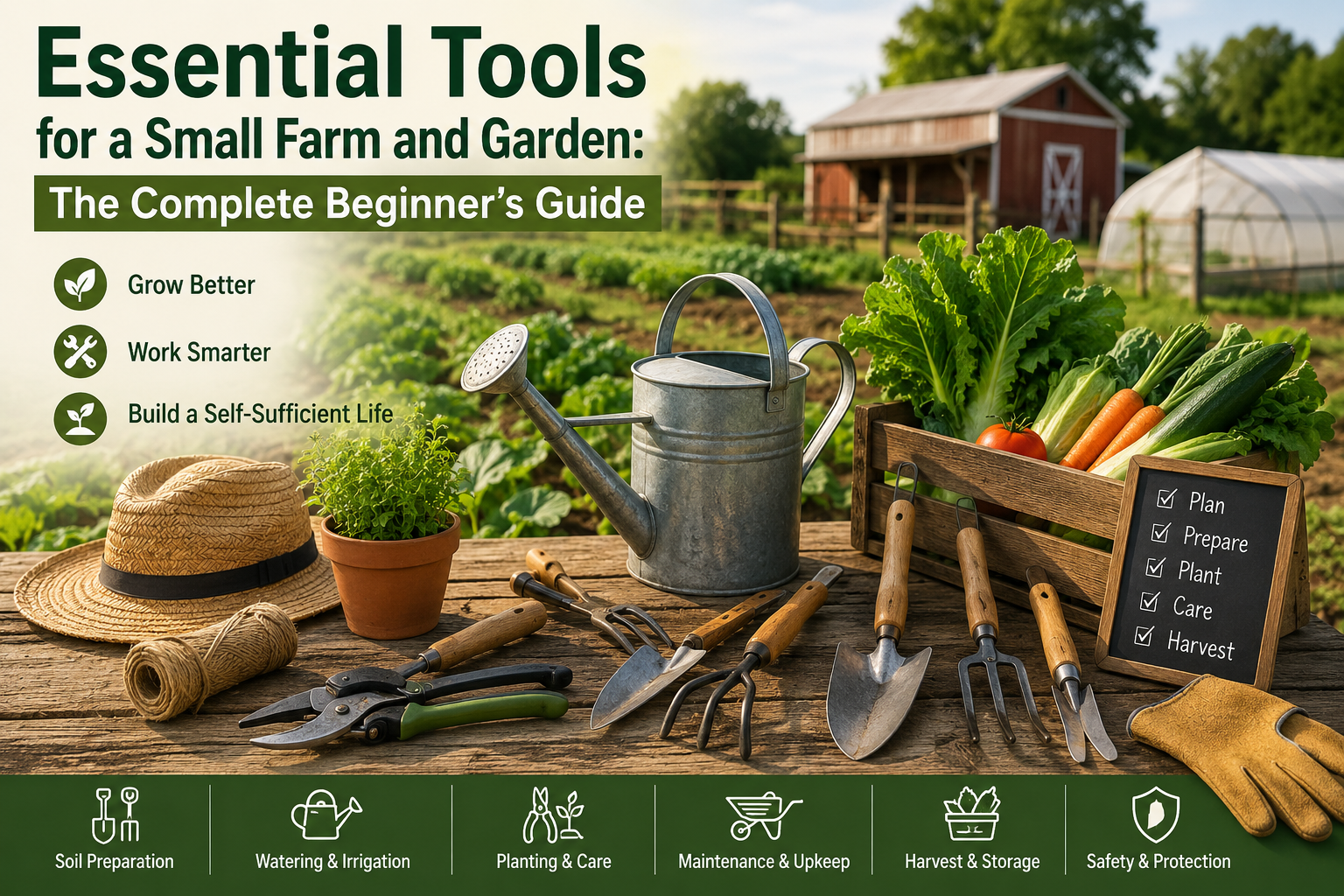
To get started, you’ll probably need basic hand tools such as a shovel, hoe, rake, pruning shears, wheelbarrow, and some DIY tools. These tools can allow you to complete a huge number of jobs without immediately investing in expensive machinery.
Power tools can be added later as the needs of the project evolve. A cordless drill, for example, may be much more useful initially than buying several specialized machines.
The rule should be simple: buy a tool because you have a job to do, not because it looks interesting to own.
11. Learn DIY Skills and Reduce Costs
DIY can become one of the most valuable skills on a small farm.
With basic knowledge of carpentry, maintenance, and repairs, you can build shelves, boxes, workbenches, small chicken coops, compost bins, supports, gates, and many other structures.
This doesn’t mean you should build absolutely everything yourself. Some structures require professional knowledge, and certain jobs can involve significant risks. But for simple projects, learning how to measure, cut, drill, screw, and assemble can save a considerable amount of money.
DIY has another benefit: it allows you to adapt solutions to your own farm. Instead of buying a standard product designed for someone else’s situation, you can build something specifically suited to your available space.
12. Use Reclaimed Materials Wisely
A farm can make use of many materials that other people no longer need.Reclaimed wood, suitable pallets, containers, old doors, and other materials can have a second life.However, “free” doesn’t automatically mean “good.”You should carefully inspect any reclaimed material.
Some types of wood may have been treated with substances that aren’t appropriate for certain uses. Containers may have previously held chemicals. Structural materials may be damaged.The rule is simple: save money, but don’t sacrifice safety.
13. Consider Buying Used Tools
Not every tool needs to be purchased new.
The secondhand market can be particularly useful for hand tools, wheelbarrows, some power tools, and certain agricultural equipment.
Before buying, inspect the condition of the product. Check handles, blades, motors, batteries, cables, wheels, and moving parts.
With power tools, pay particular attention to signs of overheating, damaged cables, or deteriorated batteries.A used tool in good condition can provide years of service for a fraction of the price of a new one.
14. Start with Small Livestock If You Really Need It
Animals can be part of a small farm, but they also create recurring expenses.
You don’t only need to purchase the animal. You also need feed, water, housing, fencing, maintenance, and, depending on the species, veterinary care.
Therefore, if your goal is to start with little money, there’s no reason to buy animals simply because a farm is “supposed” to have them.
Chickens, for example, may be an interesting option for certain projects, but even chickens require secure housing and appropriate nutrition.
Start with a number of animals that you can properly care for. It’s better to have a few well-cared-for animals than too many animals that exceed your resources.
15. Build Basic Infrastructure First
Before buying animals, make sure you have somewhere appropriate to keep them. Before planting hundreds of plants, make sure you have adequate water. Before buying machinery, make sure you have somewhere to store it. This sequence seems obvious, but many beginners do it backwards.
Basic infrastructure should be built according to the actual needs of the project. It may include fencing, storage, work areas, water systems, composting areas, and suitable livestock housing. You don’t need to build the final version of every structure on day one. You can start with simple solutions and improve them later.
Would you like to be part of our weekly newsletter? At HomeToolsStavk, we analyze businesses built from scratch, starting with simple tools and equipment and growing into profitable ventures. Discover what you need to get started, how to scale, and whether the idea is really worth pursuing.

16. Learn to Repair and Maintain Fences
Fencing can become one of the largest expenses on a farm.The larger the perimeter, the more materials you’ll need. That’s why learning basic fence repairs is important.Knowing how to tension certain types of wire, replace damaged sections, repair posts, and maintain gates can save you money for years.
Fences also serve purposes beyond marking property boundaries. They can protect crops and control livestock movement.A small investment in tools and maintenance skills can have a huge impact.
17. Don’t Buy Heavy Machinery Too Soon
A tractor may seem like the ultimate symbol of farming.But it can also become one of the most expensive and unnecessary purchases for someone just starting out. Machinery has purchase costs, fuel expenses, maintenance, storage, repairs, and sometimes additional implements.
If you have a small property, you may be able to complete many tasks manually during the early stages. For occasional jobs, you can also consider renting machinery or hiring someone who already owns the equipment.Buying machinery simply because “it might be useful someday” can consume a huge portion of your budget.
18. Learn Before Expanding
One of the cheapest ways to improve a farm is to acquire knowledge.You can learn through books, courses, farming communities, experienced farmers, practical demonstrations, and educational resources.Before planting a new crop, learn about its requirements.
Before buying an animal, learn about its feed and housing needs.Before building a structure, learn about the appropriate materials and techniques. Knowledge doesn’t take up space in the barn and, unlike a tool, doesn’t require fuel.
19. Track Your Expenses
If you want your farm to be financially sustainable, you need to know how much you’re spending.Track seeds, feed, tools, materials, repairs, water, electricity, transportation, and any other relevant expenses.Then compare those costs with the production you obtain.
You may discover that a crop that looks profitable on paper isn’t actually profitable once all expenses are included.You may also discover the opposite: a particular product may have enough demand to justify increasing production. A simple spreadsheet can become a management tool just as important as any physical tool.
20. Look for Income Sources from the Beginning
If your goal is to turn the farm into a business, don’t wait several years before thinking about how you’ll make money.That doesn’t mean you need to start selling immediately. It means you should observe from the beginning which products might have demand in your area.
Depending on local regulations and your capabilities, you might consider selling vegetables, eggs, plants, fruit, herbs, handmade products, or other agricultural products.You could also explore complementary activities such as workshops, educational experiences, or agriculture-related services.
The best income source will depend on your local market. Don’t produce first and look for buyers later. Research the market before investing heavily.
21. Think of the Farm as a System
An efficient farm shouldn’t operate as a collection of completely independent activities. The goal is to create connections between them.Plant waste can become compost.Compost can improve soil.Soil can produce crops. Crops can provide food.Some waste materials can feed composting processes.Water can be stored and used strategically.
When you start thinking this way, every resource can have more than one purpose.This mindset is particularly important when you have little money because it forces you to look for ways to get the maximum value from what you already have.
22. Avoid Going into Debt to Buy Things That Don’t Produce
Access to credit can make a farm appear larger than it really is.You can immediately purchase machinery, structures, and equipment, but those investments still need to be paid for. If the equipment doesn’t generate enough value or income, it can become a financial burden.
When you’re starting with little money, try to keep fixed costs low.A small farm that grows slowly but keeps expenses under control can be much more resilient than a large farm built quickly through debt.
23. Design a Farm You Can Actually Maintain
Another common mistake is building a farm that requires too much work.It’s easy to imagine large vegetable gardens, numerous animals, enormous orchards, and multiple structures.But every element requires maintenance.
More animals mean more feed and cleaning.More crops mean more irrigation and weed management.More structures mean more repairs.More land means more work.Before expanding, ask yourself: Do I really have the time and resources to maintain this? A slightly smaller but manageable farm can be much more satisfying and profitable.
24. Use the First Year as a Learning Phase
Your first year doesn’t have to be perfect. In fact, you’ll probably make mistakes. Some crops won’t grow as expected. You’ll buy a tool that turns out to be less useful than you thought. You’ll build something and later discover a better way to do it.
That’s part of the process. Instead of considering these mistakes failures, use them to collect information. Record what worked, what didn’t, and how much each activity cost. By the end of your first year, you’ll have something that can’t easily be bought: experience specific to your own land and your own production system.
How Much Money Do You Really Need to Start?
There is no universal figure. The cost depends primarily on whether you already have land, access to water, tools, infrastructure, and knowledge. Someone who already has a small piece of land and some tools may be able to start with a relatively small investment.
Someone else who needs to purchase land, establish a water supply, build fencing, and acquire livestock will need considerably more capital. That’s why instead of asking, “How much does a farm cost?” a more useful question is:
“What is the smallest version of my farm that I can start building with the resources I currently have?”
That question completely changes the strategy.
An Example of Starting with Little Money
Imagine that you have access to a small piece of land but a limited budget.Instead of buying livestock, machinery, and large quantities of materials, you could begin by preparing a small growing area.First, you analyze the soil and determine where you’ll get enough sunlight. Then you establish a water source and prepare a few growing beds. You use tools you already have and buy only those that are genuinely necessary.
While the first crop is growing, you can build a simple compost bin and begin preparing materials for the following season. You can also research which products have demand in your local market.After a successful first season, you can reinvest some of the income or savings into expanding the garden, improving irrigation, or introducing a new activity.Growth is slower, but the financial risk is also much lower.
The Most Expensive Mistakes When Starting a Farm
- Some mistakes can be much more expensive than others.Buying too many animals too soon is one of them.
- Buying machinery that you’ll barely use is another.
- Building structures before understanding how the system will operate can also waste materials.
- Buying land without researching its characteristics can become an even bigger problem.
- And perhaps one of the most important mistakes is trying to grow too quickly.
A farm doesn’t need to look impressive during its first year. It needs to work.
Action Plan for Starting a Farm with Little Money
If you want to turn all this information into a practical process, you can divide the project into stages.
Stage 1: Planning
Define what you want to produce, how much time you have available, and how much money you can invest without compromising your finances.
Stage 2: Resources
Inventory the land, water, tools, materials, and knowledge you already have.
Stage 3: First Production
Start with a small vegetable garden, a few productive plants, or another manageable activity.
Stage 4: Infrastructure
Build only the structures necessary to maintain and expand your first activity.
Stage 5: Evaluation
Track expenses, production, problems, and time invested.
Stage 6: Expansion
Expand only the activities that prove useful, sustainable, or profitable.This strategy allows the farm itself to gradually finance part of its growth.
Conclusion: Start Small, Learn Quickly, and Grow with Purpose
Learning how to start a farm from scratch with little money isn’t about finding a magic formula that lets you build a large agricultural operation without investment.The reality is much simpler: you need to reduce the initial size of the project, control expenses, and develop skills that allow you to do more with less.
Start with what you have. Evaluate the land. Solve the water situation first. Choose a simple production activity. Buy basic tools. Learn DIY skills. Reuse materials when it is safe to do so, and avoid buying machinery you don’t need yet.Then measure the results.If something works, expand it. If something consumes too much money or time, modify it or eliminate it.
A farm built this way may grow slowly, but every stage will be supported by real experience.And perhaps that’s the biggest advantage of starting with little money: it forces you to learn how to manage resources before you have too many resources to manage.You don’t need to build the perfect farm this year. You need to build a farm you can maintain today and improve tomorrow.




Leave a Reply