

Building a small farm can seem much more expensive than it actually is. When we think about a farm, we often imagine large properties, tractors, barns, livestock, fencing, machinery, and agricultural buildings. The problem is that this image represents a fully developed farming operation, not necessarily what someone needs when they’re just starting out.
A small farm can begin in a much simpler way. You can start with a small piece of land, a vegetable garden, a few hand tools, a reliable water source, and some basic structures. Later, you can add livestock, fruit trees, irrigation systems, storage, and other improvements as your knowledge and resources grow.
That’s why the right question isn’t simply “How much does it cost to build a farm?” but rather “How much does it cost to build the smallest functional version of the farm I want?” The answer can change dramatically depending on your goals, location, access to land, and how much work you’re willing to do yourself.
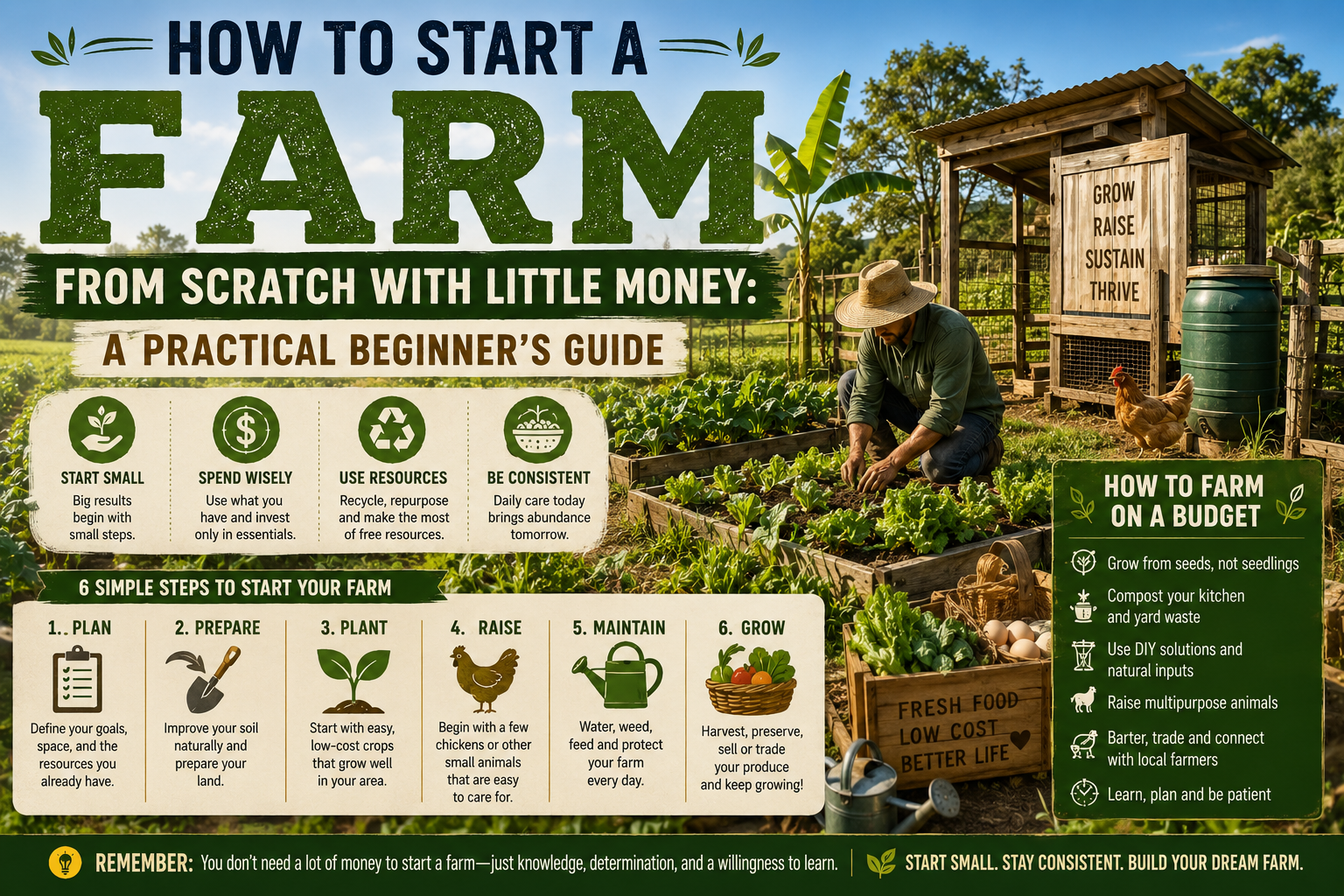
In this guide, we’ll examine the main expenses involved in building a small farm from scratch and look at different strategies for reducing your initial investment without turning the project into an endless source of expenses.
How Much Money Do You Need to Build a Small Farm?
There is no single price because there are simply too many variables.
If you already have land, access to water, and some tools, you could start a small agricultural project with a relatively low investment. On the other hand, if you need to purchase land, establish a water supply, build fencing, prepare the soil, and construct structures, the budget can increase rapidly.
A practical way to think about your budget is to divide it into three levels:
| Type of project | Characteristics | Approximate investment* |
|---|---|---|
| Basic start | Small garden, tools, and composting | $500–$2,000 |
| Functional small farm | Garden, irrigation, fencing, storage, and small livestock | $3,000–$10,000+ |
| Developed small farm | Land, infrastructure, livestock, and diversified production | $10,000–$50,000+ |
*These are general estimates and do not necessarily include the cost of land or housing. Actual costs can vary enormously depending on your country, region, availability of materials, and infrastructure requirements.
This leads to an important conclusion: you don’t need $50,000 to start building a small farm.
You can build it in stages.
1. Land: Probably the Biggest Expense
If you don’t already own land, this will probably be the most expensive part of the project.
The price of agricultural land can vary enormously depending on the country, location, road access, water availability, soil quality, terrain, and building restrictions.
An inexpensive property may look attractive, but you need to analyze what you’re actually buying.
Cheap land without water may require a huge investment to establish a water supply. An inexpensive property with poor road access can generate transportation costs for years. Land with drainage problems may require significant work before you can use it productively.
Therefore, don’t simply look for the cheapest piece of land.
Look for the property with the best combination of price, characteristics, and suitability for your project.
2. Can You Start Without Buying Land?
Yes. This is an option many people overlook. If your initial goal is to learn agriculture and develop a small production system, you could start by using a family member’s land, renting a small plot, or reaching an agreement with someone who owns unused property. This can dramatically reduce your initial investment.
You could also use a backyard if local regulations allow it. The advantage is enormous: you can find out whether you actually enjoy farming before committing to purchasing property.Buying land is a major financial decision.Learning how to grow tomatoes doesn’t require signing a mortgage.
3. Water Should Be One of Your First Priorities
After land, water can be one of the most important expenses. A small farm needs water for crops, livestock, cleaning, and other activities.If the property already has an adequate water connection, you have a significant advantage.If it doesn’t, you’ll need to investigate the alternatives available in your area. These may include:
- Connection to a public water supply.
- A well, where permitted.
- Water storage.
- Rainwater harvesting for permitted uses.
- Distribution systems.
- Storage tanks.
- Pumps.
Don’t assume that any rainwater collection system can be used for drinking. Potable water requires appropriate treatment and infrastructure. Also, regulations regarding wells, rainwater harvesting, and water use vary by jurisdiction.
4. How Much Does Land Preparation Cost?
Preparation costs depend entirely on existing conditions. If you have relatively flat, fertile land, you may need very little work.If the property is covered with dense vegetation, contains rocks, has steep slopes, or has drainage problems, costs will increase. Some of the work you may need includes:
- Clearing vegetation.
- Removing weeds.
- Preparing the soil.
- Leveling.
- Building access paths.
- Drainage.
- Preparing growing areas.
This is an excellent opportunity to save money through your own labor, provided the work is safe and appropriate for your abilities.One person with basic tools can perform some tasks manually, while others require machinery.
There’s no point renting an excavator to do a job you can safely complete with a shovel and patience.But there’s also no point spending three weeks with a shovel trying to do a job that a machine can safely complete in a few hours. The key is knowing when to save and when to pay.
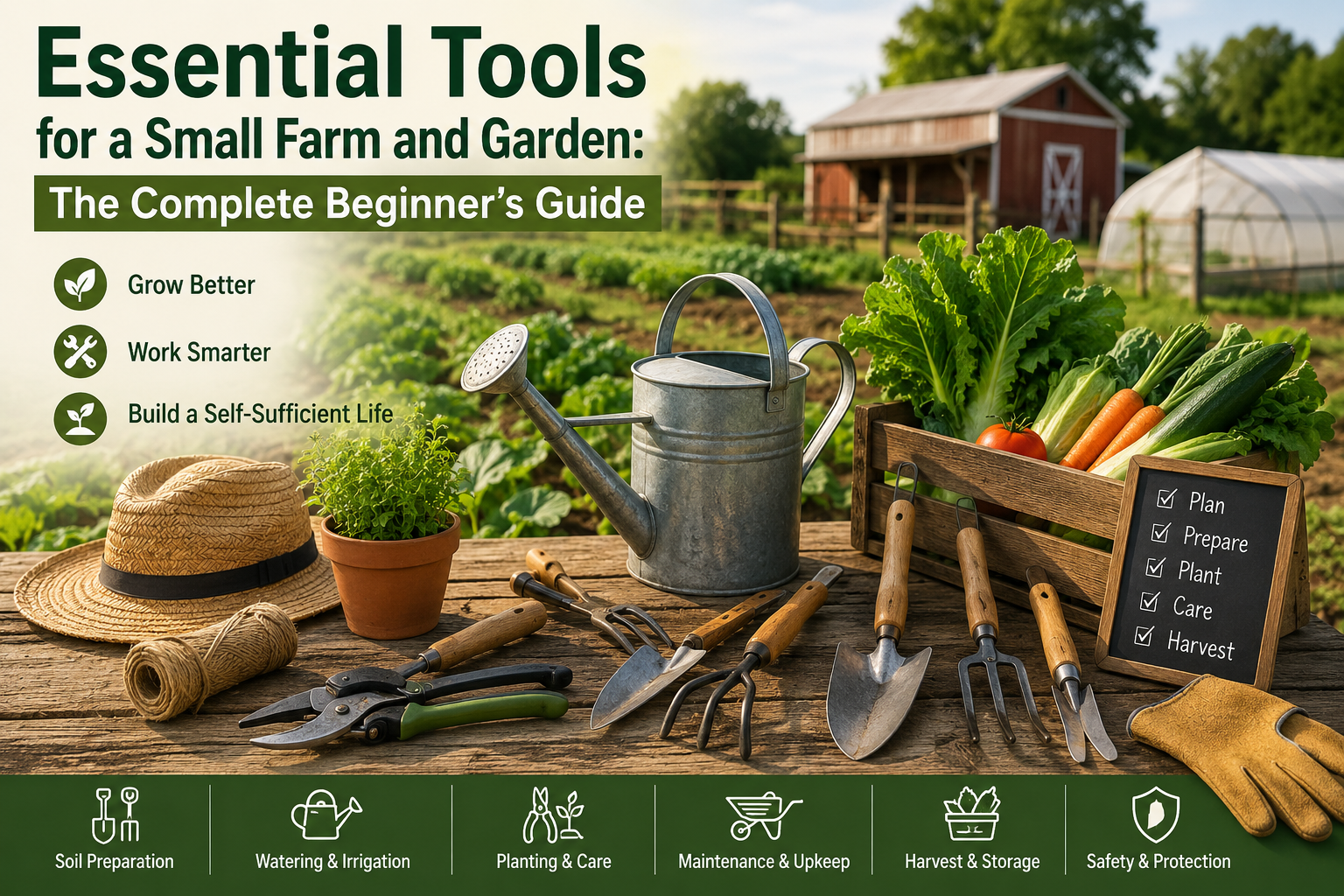
5. Basic Tools for Getting Started
You don’t need to buy an entire agricultural supply store. To start a small garden, you’ll probably need some basic hand tools. A basic toolkit might include:
- Shovel.
- Hoe.
- Rake.
- Pruning shears.
- Wheelbarrow.
- Gloves.
- Buckets.
- Tape measure.
- Hammer.
- Screwdrivers.
- Pliers.
- Adjustable wrench.
- Drill.
- Hand saw.
Depending on what you build, you can add other tools later.
A starting budget of $200 to $500 may allow you to assemble a basic collection if you shop strategically and consider used tools in good condition.
6. Don’t Buy Agricultural Machinery Immediately
This is where many beginners make a huge mistake.They see a used tractor, tiller, brush cutter, trailer, and other machines and assume they need all of them. Not necessarily.If you’re working a small area, many tasks can be done with hand tools.
For occasional jobs, you can rent machinery.You can also hire someone who already owns the equipment. This can be much cheaper than purchasing a machine you’ll use five times a year.Remember that the cost of machinery doesn’t end when you buy it. You’ll also have to pay for:
- Fuel.
- Maintenance.
- Repairs.
- Storage.
- Replacement parts.
- Attachments.
A cheap machine sitting broken behind the barn isn’t an investment.It’s industrial decoration.
7. A Vegetable Garden Can Be One of the Cheapest Parts
If you want to start with little money, the vegetable garden should be one of your first priorities.You can start with a relatively small growing area and expand it gradually.Main expenses include:
- Seeds.
- Soil amendments or organic matter.
- Tools.
- Irrigation.
- Pest protection.
- Materials for beds or supports.
Depending on the size and resources available, you could start with a few hundred dollars.You can reduce costs even further by using appropriate seeds, homemade compost, and safely reclaimed materials.
8. How Much Does It Cost to Install Irrigation?
The irrigation system depends on the size of your garden and your water source.For a small area, you can use a relatively simple setup.A basic system may include:
- Tubing.
- Connectors.
- Emitters.
- Filters.
- Valves.
- Timer, if needed.
A small installation may cost approximately $50–$300, while larger systems can easily exceed that amount.The advantage of installing a good system early is that it reduces the amount of time required for manual watering.It can also help you use water more efficiently.
9. Fencing Can Become a Significant Expense
If you have livestock, you’ll need some type of fencing. Even if you don’t have animals, fencing can be useful for protecting crops from wildlife or separating different areas of the property. Costs depend on:
- Length.
- Material.
- Height.
- Type of animal.
- Number of gates.
- Type of posts.
- Labor.
For example, fencing a small garden can be relatively inexpensive. Fencing several acres for livestock is a completely different story. That’s why you should determine exactly what you need to protect before buying hundreds of feet of fencing material.
10. Building a Chicken Coop
If you want to raise chickens, you’ll need suitable housing.A simple chicken coop can be built using wood, wire mesh, and appropriate materials. This is another area where DIY skills can significantly reduce costs.You could build a small chicken coop for a few hundred dollars, depending on its size and the materials you use.But don’t cut costs when it comes to safety.
The coop needs to protect the birds from predators and provide adequate ventilation, space, water, and appropriate conditions. A cheap chicken coop that allows a predator inside at night isn’t cheap.It’s simply a repeat purchase.
11. How Much Does It Cost to Buy Livestock?
This depends entirely on the species. Chickens generally require a lower initial investment than larger livestock.But remember that the purchase price is only the beginning. You need to budget for:
- Feed.
- Water.
- Shelter.
- Fencing.
- Equipment.
- Maintenance.
- Veterinary care when necessary.
Before purchasing any animal, calculate the approximate annual cost. A cheap animal can be expensive to maintain.
12. Planting Fruit Trees
Fruit trees are a long-term investment. The cost of each tree depends on the species, size, and variety.You can start with a few trees and expand your orchard each year.
The advantage is that once properly established, some trees can produce fruit for many years. However, you need to research which varieties are suitable for your climate.You should also consider:
- Available space.
- Irrigation needs.
- Pollination.
- Soil type.
- Pests.
- Harvest season.
Don’t plant a tree simply because you like the fruit it produces. First make sure it can actually thrive where you live.
13. Building a Composting Area
Composting is one of the smallest investments you can make.A simple compost bin can be built using reclaimed wood or other suitable materials.You can even start with a very basic system. The goal is to use appropriate organic waste and transform it into something useful for the soil.
This can reduce the amount of fertilizer you need to purchase while also reducing household organic waste.It also perfectly represents the philosophy of a small farm:turning waste into a resource.
14. Building a Small Storage Shed
Over time, you’ll accumulate tools, seeds, materials, feed, and other supplies. That’s why storage should be part of your planning.You don’t need to start with a huge barn.A small shed may be enough during the early stages.
You can build it gradually and design it around your actual needs.Good storage should protect your tools and materials from moisture, rain, and other conditions that can cause deterioration.
15. How Much Can You Save by Doing DIY Work?
This is one of the biggest opportunities for saving money. If you know how to build simple structures, you can significantly reduce labor costs. You can build:
- Garden beds.
- Compost bins.
- Shelving.
- Worktables.
- Small chicken coops.
- Storage systems.
- Gates.
- Supports.
- Planters.
- Workbenches.
But don’t try to save money by doing work you don’t have the skills to perform. Electrical work, complex structures, gas installations, certain plumbing jobs, and other specialized tasks may require professionals.Saving $500 in labor makes little sense if the result eventually costs you $5,000 in repairs.
Would you like to be part of our weekly newsletter? At HomeToolsStavk, we analyze businesses built from scratch, starting with simple tools and equipment and growing into profitable ventures. Discover what you need to get started, how to scale, and whether the idea is really worth pursuing.

16. Buying Used Can Significantly Reduce Your Budget
A small farm doesn’t need to be equipped entirely with new products. You can find used tools, wheelbarrows, shelving, storage containers, some agricultural equipment, and other materials.Inspect everything carefully before buying. For power tools, check cables, motors, and batteries.For hand tools, inspect handles, blades, and moving parts.
For agricultural equipment, check for leaks, excessive wear, and maintenance issues. A good used purchase can save you a lot of money. A bad used purchase can become a machine for manufacturing repair bills.
17. How Much Does It Cost to Build a Small Farm Without Buying the Land?
Let’s look at a practical example. Suppose you already have access to land. An initial budget could look something like this:
| Item | Approximate budget |
|---|---|
| Basic tools | $300 |
| Seeds and plants | $150 |
| Garden preparation | $200 |
| Irrigation system | $150 |
| Small fence | $400 |
| Composting | $50 |
| Basic storage | $300 |
| DIY materials | $250 |
| Initial total | $1,800 |
This example isn’t a universal price. You could spend less by using reclaimed materials and tools you already own. You could also spend considerably more if you need additional infrastructure. The point is to demonstrate that small-scale agricultural production can begin without requiring tens of thousands of dollars.
18. Example Budget for a Small Farm with Chickens
Suppose you want to add a small flock of chickens. You might consider:
| Item | Approximate budget |
|---|---|
| Chicken coop | $300 |
| Fencing | $250 |
| Feeders and waterers | $100 |
| Chickens | $100–$250 |
| Initial feed supply | $100 |
| Accessories | $50 |
| Additional total | $900–$1,050 |
Again, prices can vary considerably. If you build the coop using available materials and buy some equipment secondhand, the cost can be reduced.
19. What Should You Buy First?
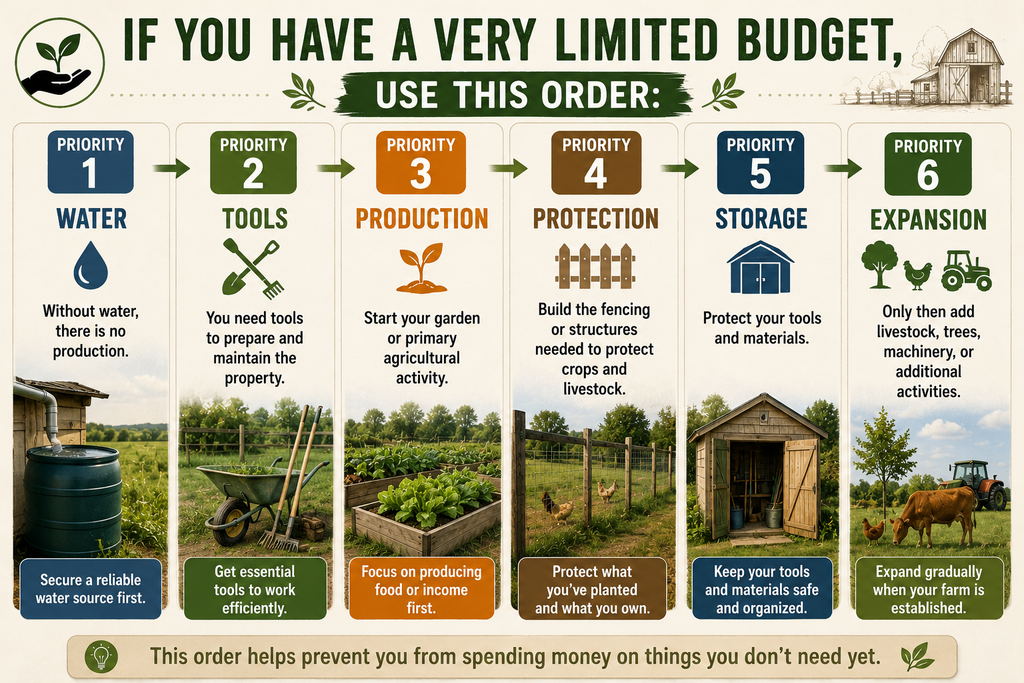
20. What Should You NOT Buy at the Beginning?
If your budget is limited, avoid certain purchases. You don’t immediately need:
- A large tractor.
- A huge barn.
- Dozens of animals.
- Specialized machinery.
- Large automated systems.
- Tools you’ll only use once.
- Professional agricultural equipment.
Buy something when there’s a real need for it. The best tool isn’t necessarily the most expensive. It’s the one you actually use frequently.
21. How to Build a Farm with $1,000
With $1,000, you probably won’t be able to buy a complete agricultural property. But if you already have access to land, you can start a small project. One possible allocation could be:
$250: tools.
$150: seeds and plants.
$200: irrigation.
$200: fencing materials.
$100: compost and soil preparation.
$100: miscellaneous materials.
The goal wouldn’t be to build a finished farm. It would be to build the first part of a farm. Then you can reinvest.
22. How to Build a Farm with $5,000
With a $5,000 budget and access to land, you can develop something considerably more complete. You could allocate approximately:
- $500 to tools.
- $500 to irrigation.
- $1,000 to fencing.
- $500 to seeds and plants.
- $750 to storage.
- $750 to small livestock infrastructure.
- $500 to DIY materials.
- $500 as an emergency fund.
That last category is important. Don’t spend 100% of your budget. A farm needs repairs, replacements, and unexpected expenses. Having money set aside can prevent you from having to stop the project because of a breakdown.
23. The Farm Emergency Fund
Once you start producing, unexpected expenses will appear. A pump may fail.A fence may break. A tool may be damaged. An animal may need care.An irrigation system may develop a leak.That’s why, whenever possible, I recommend setting aside 10% to 20% of your initial budget for unexpected expenses. Don’t consider that money available for buying another tool you saw online. It’s an emergency fund.
24. The Farm Doesn’t End When You Build It
Another mistake is thinking about the budget only as an initial investment. A farm has recurring costs. Some examples include:
- Seeds.
- Animal feed.
- Water.
- Electricity.
- Repairs.
- Fuel.
- Fertilizers.
- Tools.
- Maintenance.
- Transportation.
That’s why before starting, you should ask yourself: Can I afford to maintain this farm after building it? Building it is only half the problem. Maintaining it is the other half.
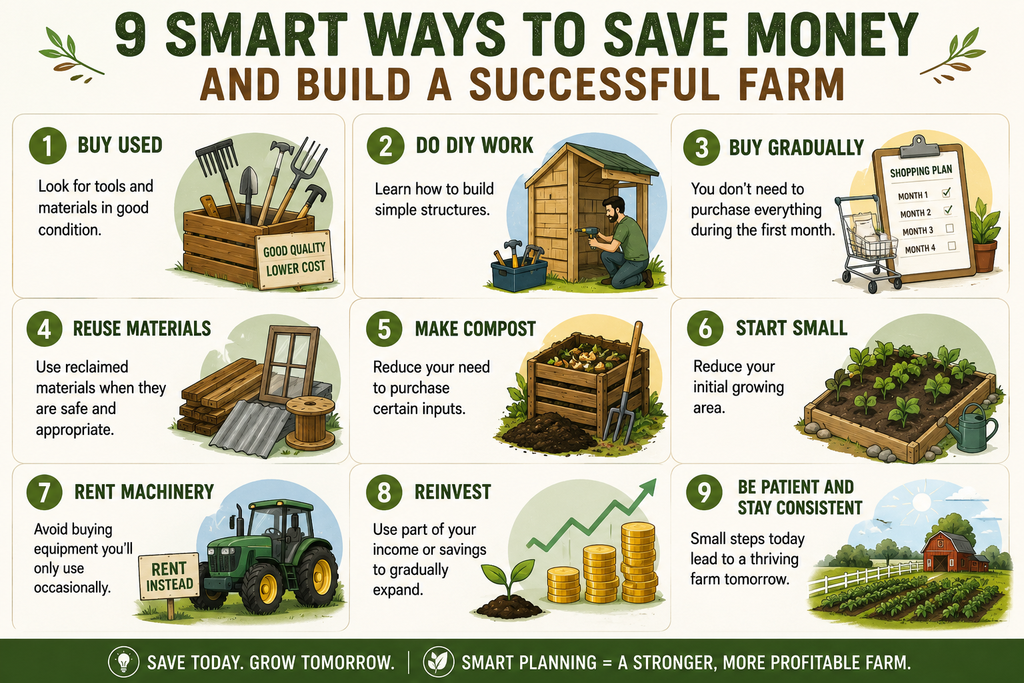
How to Reduce the Cost of a Small Farm
There are several strategies that can significantly reduce your investment.
The Most Important Budget Isn’t Money
There’s another resource many beginners forget:time. You can have $10,000 available and still fail if you don’t have enough time to maintain the farm.A garden needs attention.Animals need daily care.Fences need maintenance.Tools need repairs.
Water systems need monitoring. Before building a large farm, calculate how many hours per week you can realistically dedicate to it.A 1-acre farm that you can properly maintain may be better than a 10-acre farm that ends up abandoned.
A Small Farm Should Grow with Its Results
The smartest strategy for someone with a limited budget is to build in stages. First, create a small productive area. Then measure the results.Determine how much you spent.Calculate how much you produced. Observe how much time you needed.
Then decide what deserves to be expanded.If the garden works, expand it. If the chickens are manageable, increase the flock. If the fruit trees thrive, plant more.If an activity consumes too much money, reconsider whether it’s actually worth continuing. This way, each new investment is based on real information rather than enthusiasm alone.
Conclusion: How Much Do You Really Need to Build a Small Farm?
The answer depends on what you mean by “farm.”
If you already have land and want to start with a small garden, basic tools, and simple systems, you could begin with a few hundred or a few thousand dollars.
If you want to add fencing, livestock, storage, water systems, and more complete infrastructure, the budget can rise to several thousand dollars.
And if you also need to purchase land, build a home, and develop major infrastructure, the investment can quickly reach tens of thousands of dollars or more.
That’s why you shouldn’t try to build the entire farm at once. Start with water, tools, and production. Then add infrastructure. Then livestock and perennial crops.Finally, incorporate more sophisticated systems when you actually need them.
The best small farm isn’t necessarily the one with the most buildings, animals, or machinery. It’s the one that produces something useful, can be maintained financially, and has the ability to grow without putting the owner’s finances at risk. And that’s probably the best rule for anyone starting from scratch: Don’t build the farm you can imagine. First build the farm you can afford, maintain, and improve.




Leave a Reply